
Electrophilic addition
Addition reaction where a π bond breaks forming two σ bonds.

V8rik ( talk ) · CC BY-SA 3.0
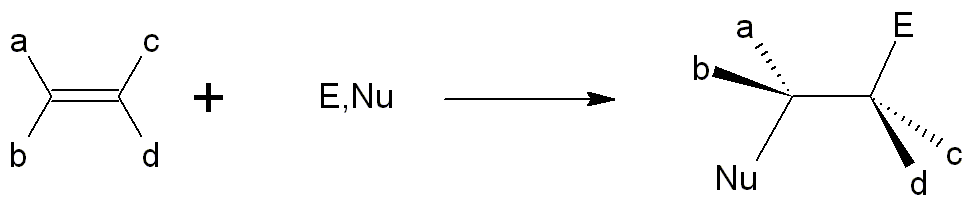
Electrophilic addition is a type of addition reaction in organic chemistry in which a compound containing a double or triple bond undergoes breaking of a π bond and formation of two new σ bonds. The reaction is driven by an electrophile that forms a covalent bond with an electron-rich unsaturated bond, generating a carbocation intermediate that then combines with a nucleophile.
- field
- Organic chemistry
- known_for
- Addition reactions to alkenes and alkynes involving electrophiles
- key_feature
- Regioselectivity often determined by Markovnikov's rule; organoborane compounds give anti-Markovnikov additions
Lore & Background
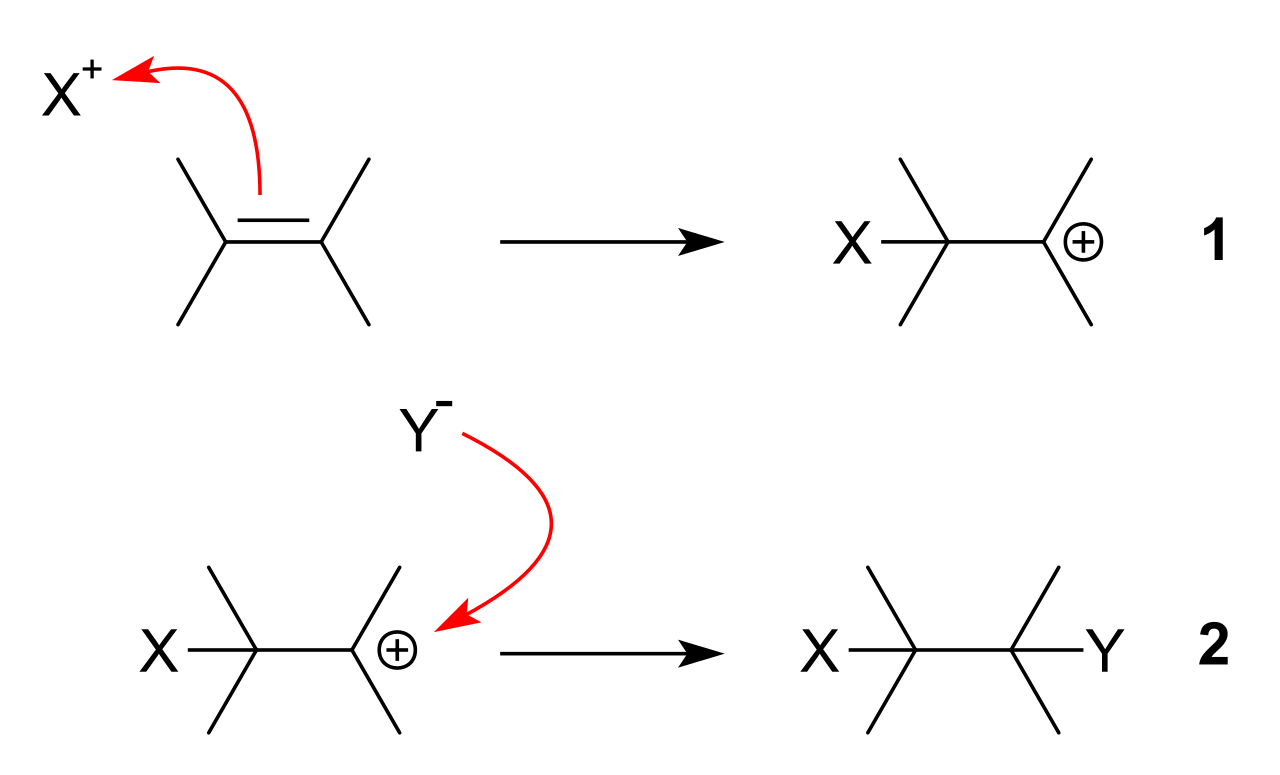
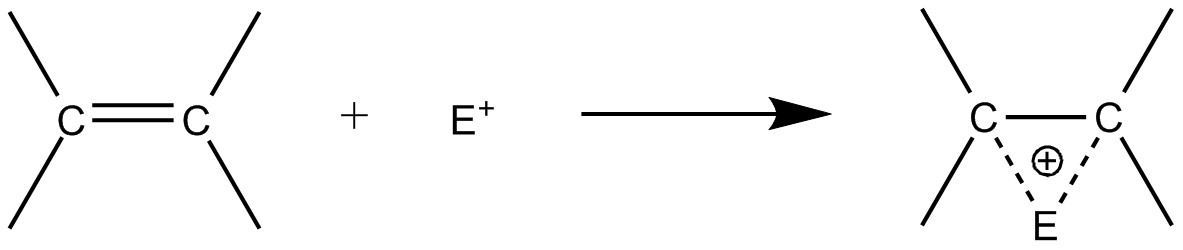
In an electrophilic addition, the driving force is the formation of an electrophile X+ that forms a covalent bond with an electron-rich, unsaturated C=C bond. The positive charge on X is transferred to the carbon-carbon bond, forming a carbocation during the formation of the C-X bond. In the second step, the positively charged intermediate combines with an electron-rich species to form the second covalent bond, a process similar to the nucleophilic attack in an SN1 reaction. The exact nature of the electrophile and the positively charged intermediate are not always clear and depend on reactants and reaction conditions.
Reader's Guide
Electrophilic addition is a fundamental reaction type in organic chemistry, essential for understanding how alkenes and alkynes react with various reagents. Its significance lies in its broad applicability: typical electrophilic additions include halogen addition, hydrohalogenation, hydration, hydrogenation, oxymercuration, hydroboration-oxidation, and the Prins reaction. Regioselectivity, often governed by Markovnikov's rule, is critical in asymmetric additions, though organoborane compounds provide anti-Markovnikov outcomes. The reaction contrasts with electrophilic aromatic substitution, where attack on an aromatic system leads to substitution rather than addition. The mechanism's uncertainty in some cases—depending on reactants and conditions—highlights the complexity and ongoing study within the field.
Did You Know?
- The second step of electrophilic addition is the same nucleophilic attack process found in an SN1 reaction.
- Organoborane compounds give anti-Markovnikov additions in electrophilic addition reactions.
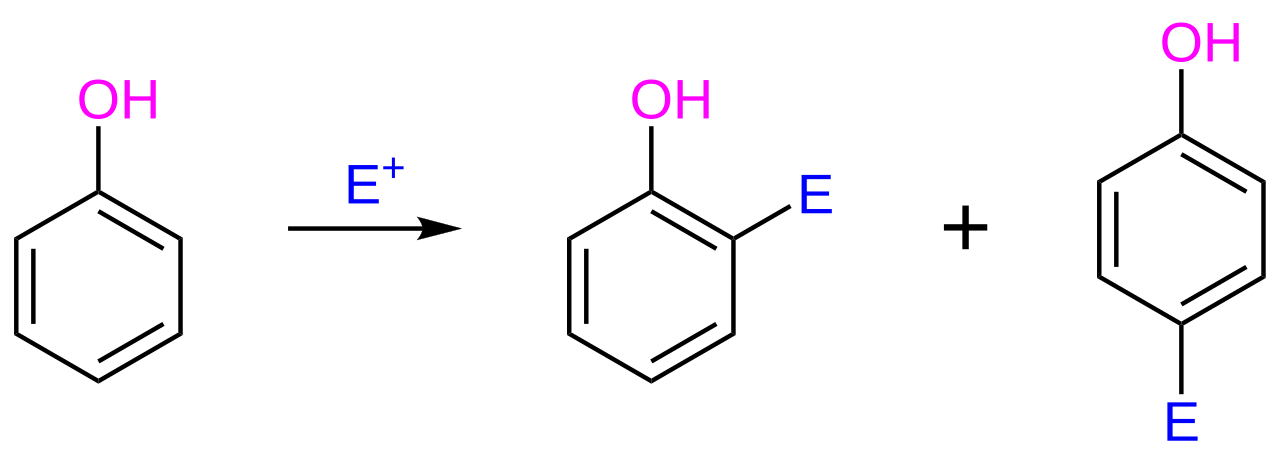
- Electrophilic attack to an aromatic system results in electrophilic aromatic substitution rather than an addition reaction.
- Typical electrophilic additions include halogen addition, hydrohalogenation, hydration, hydrogenation, oxymercuration, hydroboration-oxidation, and the Prins reaction.
The Two-Step Choreography of Electrophilic Addition
An electrophilic addition reaction is fundamentally a two-step transformation in which a molecule bearing a double or triple bond surrenders its π bond and gains two fresh σ bonds in its place. The engine behind this process is an electrophile, conventionally written as X⁺, which is drawn to the electron-rich, unsaturated carbon-carbon double bond. When X⁺ latches onto one of the carbons, the positive charge does not simply vanish; it migrates across the C–C framework, generating a carbocation at the neighboring carbon. This intermediate then invites a second, electron-rich species to close the ring of bonding. Notably, this second step mirrors the nucleophilic attack that characterizes an Sₙ1 substitution, meaning the same fundamental logic of a positively charged center seeking an electron donor governs both processes. The entire sequence—breaking one π bond, forging two σ bonds, and passing a positive charge from one atom to another—defines the electrophilic addition family and distinguishes it from other addition pathways.
Regioselectivity and the Markovnikov Compass
In any asymmetric electrophilic addition to a carbon framework, the question of which carbon receives which fragment is not arbitrary; it is governed by regioselectivity, and the most widely invoked guide is Markovnikov's rule. Under this principle, the electrophile preferentially attaches to the less substituted carbon of the double bond, placing the carbocation on the more substituted and therefore more stable carbon, so that the incoming nucleophile ultimately bonds to the more substituted site. However, the chemical world is not monolithic. Organoborane compounds, encountered in hydroboration-oxidation sequences, deliver the opposite outcome—what chemists call anti-Markovnikov addition—flipping the expected regiochemical result. Furthermore, when the unsaturated system is aromatic rather than a simple alkene, the electrophilic attack does not proceed as an addition at all; instead, it triggers electrophilic aromatic substitution, preserving the aromatic ring. These distinctions remind us that the same underlying electrophilic logic can yield dramatically different products depending on the substrate's architecture.
A Repertoire of Classic Electrophilic Additions
The electrophilic addition family is not a single reaction but a constellation of well-characterized transformations, each defined by its reagent and the functional group it installs across the former double bond. Halogen addition reactions deploy X₂ to place two halogens on adjacent carbons. Hydrohalogenations use HX to introduce a hydrogen and a halogen. Simple hydration brings water across the bond, while hydrogenation adds H₂ to saturate the system. Oxymercuration reactions employ mercuric acetate in the presence of water to achieve a hydration-like outcome through a different mechanistic pathway. Hydroboration-oxidation, utilizing diborane, stands apart by delivering an anti-Markovnikov alcohol. The Prins reaction, which couples formaldehyde and water, represents yet another entry in this catalog. Together, these reactions illustrate the remarkable versatility of the electrophilic addition framework: the same core logic of electrophile attack, carbocation formation, and nucleophilic capture can be tuned by reagent choice to produce halides, alcohols, saturated hydrocarbons, or more complex oxygenated products.
The Elusive Carbocation and the Role of Conditions
The carbocation that appears in the first step of an electrophilic addition is not a fixed, universal entity. The exact nature of the electrophile that initiates the reaction and the precise identity of the positively charged intermediate are not always straightforward to pin down; they shift with the particular reactants employed and the conditions under which the reaction is carried out. This variability means that what looks like a simple two-step addition can, in practice, involve subtle changes in how the positive charge is distributed, how the intermediate is stabilized, and which nucleophile ultimately captures it. The second step, where the electron-rich species attacks the carbocation, follows the same nucleophilic-attack logic seen in Sₙ1 chemistry, yet the specific reagent identities and reaction conditions can alter the product distribution. In short, the carbocation is less a single, well-defined species and more a reactive waypoint whose character is sculpted by the surrounding chemical environment, making each electrophilic addition a nuanced event rather than a one-size-fits-all template.
Gallery


Frequently Asked Questions
Who is Electrophilic addition?
Electrophilic addition is a core reaction class in organic chemistry in which an electron-poor species attacks an electron-rich multiple bond (C=C or C≡C), converting one π bond into two new σ bonds. It is the primary pathway for functionalizing alkenes and alkynes in both the lab and industry.
What are Electrophilic addition's powers/role?
Its signature move is generating a carbocation intermediate after the electrophile bonds to the unsaturated carbon, which is then trapped by a nucleophile. Regioselectivity in most cases follows Markovnikov's rule, though organoborane reagents can reverse the outcome to anti-Markovnikov addition.
How does Electrophilic addition's story end?
The mechanism closes when the nucleophile attacks the carbocation, forming the second new σ bond and delivering a fully saturated product. The net result is that the original π bond is gone and two new single bonds have been installed across what was once a double or triple bond.
Why is Electrophilic addition important?
It underpins the large-scale and laboratory synthesis of alcohols, alkyl halides, and countless other functionalized molecules starting from simple hydrocarbons. Mastery of its regioselectivity and stereochemical outcomes is essential for rational synthetic planning.
What is the key twist in Electrophilic addition's plot?
The carbocation intermediate is the dramatic midpoint—it dictates regioselectivity and opens the door to hydride or alkyl shifts before the nucleophile arrives. This single intermediate is what separates electrophilic addition from concerted addition pathways and gives the reaction its characteristic Markovnikov bias.
More in Organic Chemistry And Reaction Mechanisms 1-22
Spotted an error? Know more?
This is a living reference — every entry is fact-audited, and reader corrections feed straight into our audit queue. Suggest an edit · See this site's audit record