
Divergent synthesis
A strategy to generate diverse chemical libraries efficiently.

Blaboo10 · CC BY-SA 3.0
Divergent synthesis is a strategy in chemistry aimed at improving the efficiency of chemical synthesis, often used as an alternative to convergent or linear synthesis. It is significant for enabling the rapid generation of large libraries of chemical compounds, which can be screened for desirable properties.
- field
- Chemistry
- known_for
- Strategy to improve efficiency of chemical synthesis by generating libraries of compounds
- type
- Chemical synthesis strategy
Lore & Background
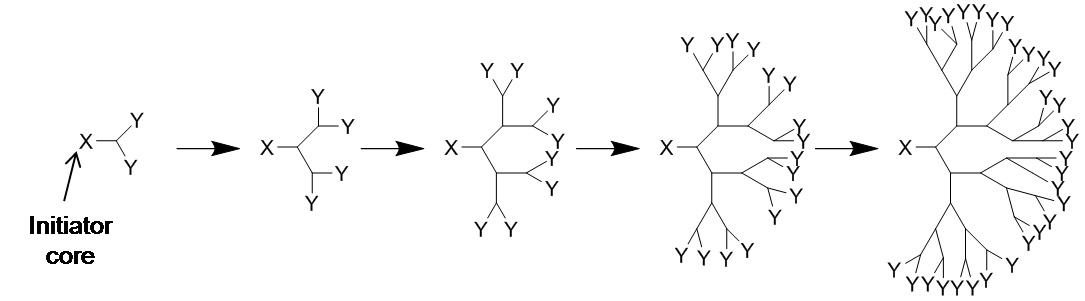
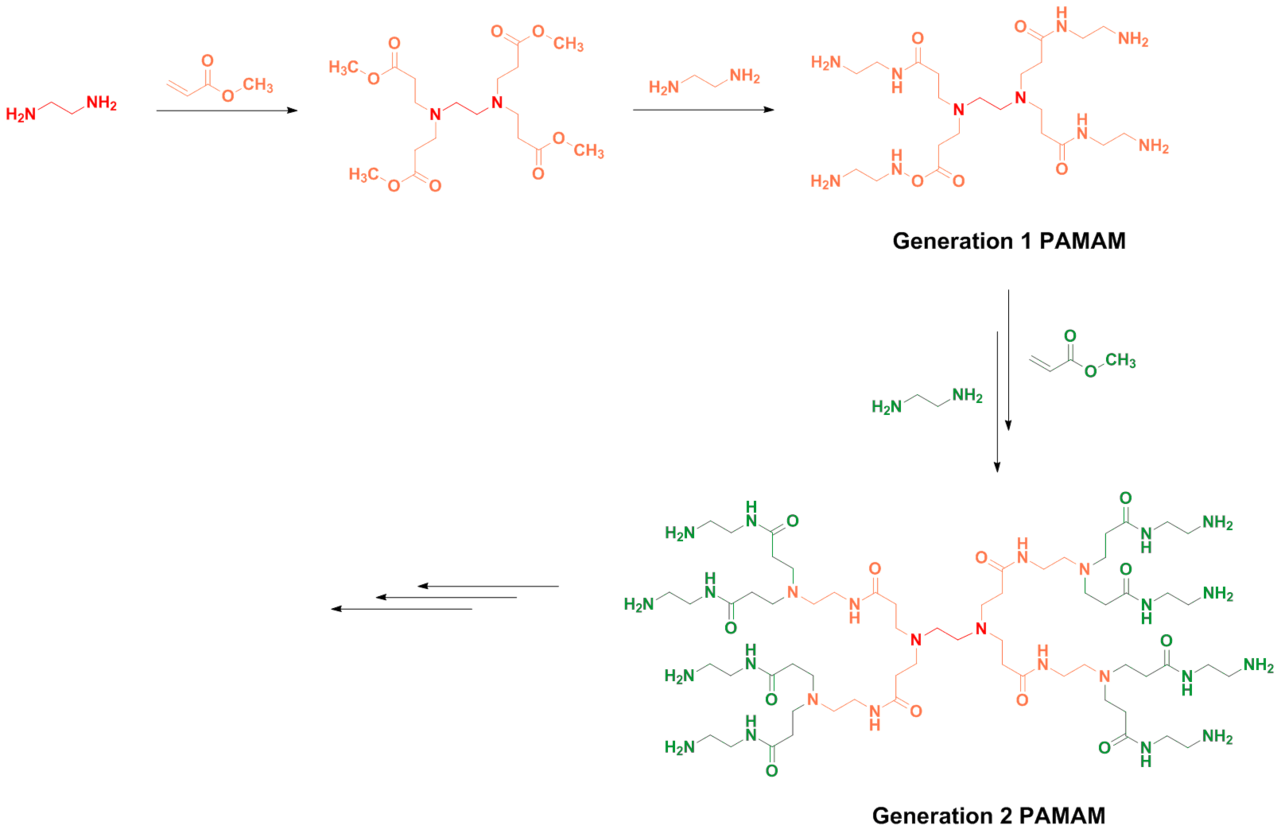
Another strategy starts from a molecule as a central core, with successive generations of building blocks added. A good example is the divergent synthesis of dendrimers, where in each generation a new monomer reacts to the growing surface of the sphere. This approach is distinct from diversity oriented synthesis (DOS), which emphasizes skeletal diversity, as seen in the functionalization of a Petasis reaction product to yield unique molecular skeletons in one generation.
Reader's Guide
Divergent synthesis holds significance as a foundational approach in combinatorial chemistry and materials science. By enabling the rapid creation of large compound libraries, it accelerates the discovery of new molecules with potential applications in drug development and other fields. The strategy contrasts with linear and convergent syntheses, offering a path to high molecular diversity from a single starting point. Its application to dendrimers illustrates its utility in constructing complex, multi-layered structures. The related concept of diversity oriented synthesis (DOS) further expands this by focusing on skeletal diversity, as demonstrated by the generation of unique molecular skeletons from a single functionalized compound. Together, these strategies have influenced modern chemical research, though the source article does not provide specific dates or broader historical context.
Did You Know?
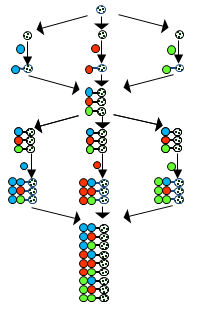
- Divergent synthesis can generate a library of compounds by reacting a molecule with a set of reactants, then further reacting each product.
- An example of divergent synthesis is the generation of dendrimers, where monomers add to the growing surface of a sphere.
- Diversity oriented synthesis (DOS) is a related strategy emphasizing skeletal diversity, as in the functionalization of a Petasis reaction product.
- The source article lists DOS drugs including Dosabulin, Gemmacin B, ML238, and Robotnikinin.
From Obscurity to Click Chemistry
The thiol-ene reaction, also called alkene hydrothiolation, joins a thiol group with a carbon-carbon double bond to produce a thioether. Although the transformation was first documented in 1905, it languished in relative obscurity for nearly a century. It was not until the late 1990s and early 2000s that chemists recognized its practical feasibility and the breadth of applications it could serve. The reaction earned a place among click chemistry reactions because it delivers high yields, predictable stereoselectivity, fast rates, and a strong thermodynamic driving force. Its defining synthetic feature is the anti-Markovnikov addition of the thiol across the alkene, a regiochemical outcome that makes the product predictable and useful. Because of these combined attributes, the reaction has become a cornerstone tool in organosulfur chemistry and a candidate for future roles in materials and biomedical science.
Two Roads to the Same Product
Thiol-ene additions can proceed through two distinct mechanistic routes, both arriving at the same anti-Markovnikov thioether product. The first is a free-radical pathway, triggered by ultraviolet light, thermal energy, or chemical radical initiators. These initiators generate a thiyl radical, which attacks the alkene to create a carbon-centered radical. A chain-transfer step then abstracts a hydrogen atom from another thiol molecule, regenerating a new thiyl radical and allowing the cycle to repeat. This propagation-and-transfer sequence can be harnessed to build homogeneous polymer networks, and because the reaction proceeds rapidly under ambient atmospheric conditions, it sidesteps the oxygen-inhibition problem that plagues many photopolymerization strategies. The second route is a Michael addition, catalyzed by a base or a nucleophile, which delivers the same regiochemical outcome without invoking radical intermediates. Together, these two pathways give synthetic chemists flexible options depending on the substrate and the desired polymer architecture.
Reading the Speed of Reaction
Understanding how fast a thiol-ene reaction proceeds requires examining the interplay between the propagation step and the chain-transfer step. The overall rate is governed by the ratio of the propagation rate constant to the chain-transfer rate constant, and the concentration of the radical intermediate is set by whichever of the two steps is slower. When propagation is much faster than chain-transfer, the reaction becomes first order in thiol concentration and chain-transfer is rate-limiting. When the reverse is true, the rate depends on alkene concentration and propagation is the bottleneck. When the two rates are comparable, the reaction shows half-order dependence on both reactants. The alkene's electronic character plays a decisive role: electron-rich alkenes such as vinyl ethers, allyl ethers, and norbornene react far more rapidly than conjugated or electron-poor alkenes like butadiene. Under weak photoinitiation conditions, radical generation itself can become rate-limiting, producing an induction period that gives the kinetic curve a Gaussian-like shape rather than a simple exponential decay.
Building Molecules for Medicine and Materials
The practical appeal of the thiol-ene reaction lies in its ability to combine the speed and reliability of click chemistry with the architectural control of radical photopolymerization. Because the reaction proceeds quantitatively and rapidly under ambient atmospheric conditions, it avoids the oxygen-inhibition that traditionally limits light-driven polymerization in nanotechnology, biomaterials, and general material science. The carbon-centered radical intermediate can be directed toward either step-growth or chain-growth polymerization depending on the specific thiol and ene functional groups chosen, enabling the synthesis of uniform, well-defined polymer networks. Researchers have also shown that intermolecular interactions between the thiol and alkene partners can be tuned to fine-tune the polymerization profile. With its anti-Markovnikov regiochemistry, high stereoselectivity, and broad substrate tolerance, the reaction is widely regarded as a foundational tool that may underpin the next generation of advanced materials and biomedical devices.
Gallery


Frequently Asked Questions
What is divergent synthesis in organic chemistry?
Divergent synthesis is a strategy in which a single starting material is branched into multiple distinct products to build a broad set of compounds efficiently. It is widely used to rapidly assemble large chemical libraries for property screening.
How does divergent synthesis differ from convergent synthesis?
Convergent synthesis assembles several pre-built fragments into a final target, whereas divergent synthesis radiates outward from one core to yield many different molecules. In practice the two approaches are often blended, but divergent synthesis prioritizes breadth of product diversity.
Why is divergent synthesis important in pharmaceutical research?
It lets chemists quickly generate large libraries of structurally related compounds that can be screened for biological activity. That speed and breadth make it a cornerstone of early-stage drug discovery and lead optimization.
What is the main advantage of divergent synthesis over a purely linear route?
Because each branch is shorter, divergent synthesis avoids the compounding yield losses and error accumulation typical of long linear sequences. A single intermediate can also feed into many downstream products, boosting overall efficiency.
In what contexts is divergent synthesis most commonly applied?
It features heavily in combinatorial chemistry, medicinal chemistry, and natural-product analogue synthesis where many variants of a common scaffold are needed. Researchers typically pair it with high-throughput screening to identify promising candidates.
More in Organic Chemistry And Reaction Mechanisms 1-22
Spotted an error? Know more?
This is a living reference — every entry is fact-audited, and reader corrections feed straight into our audit queue. Suggest an edit · See this site's audit record