
Cycloaddition
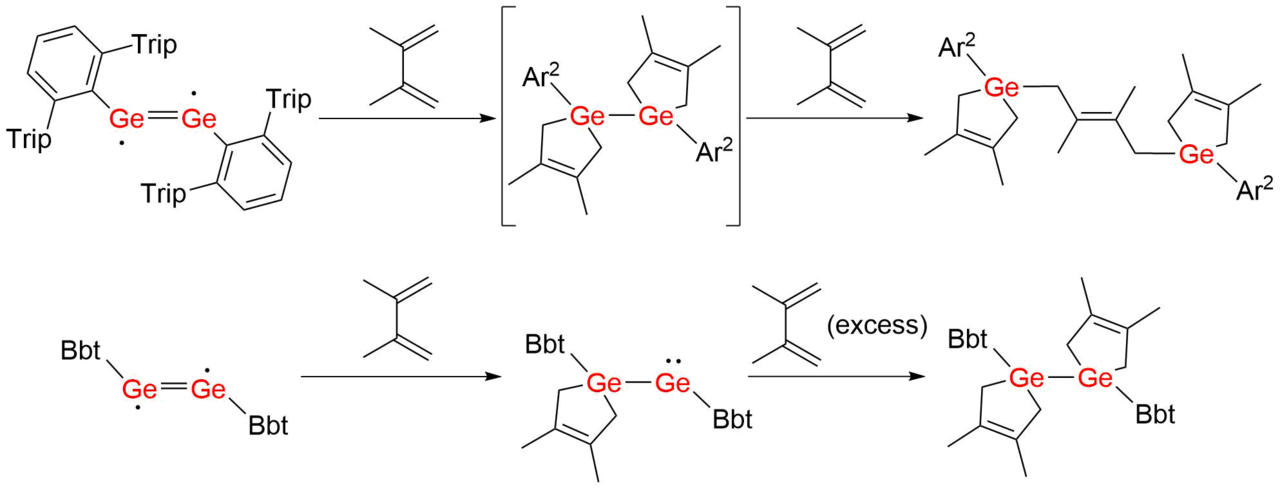
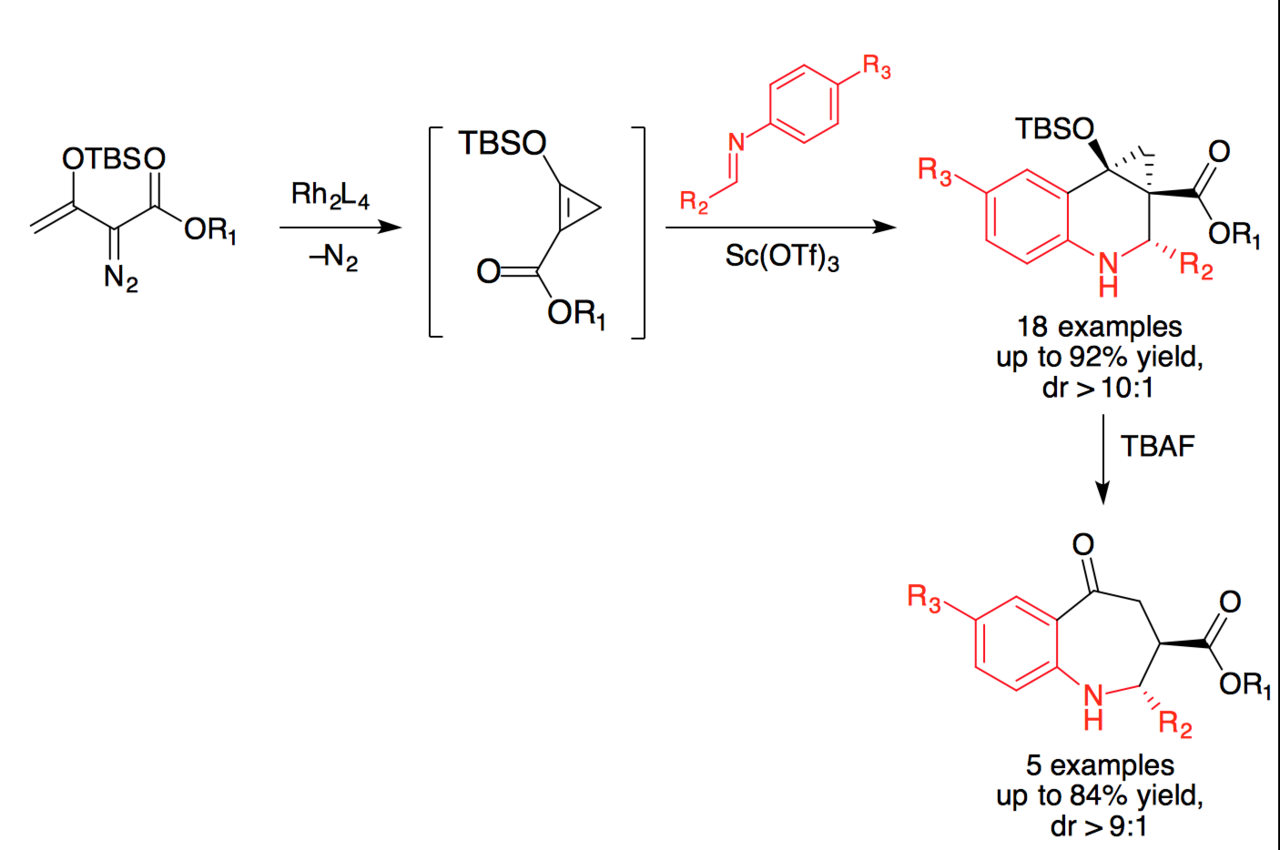
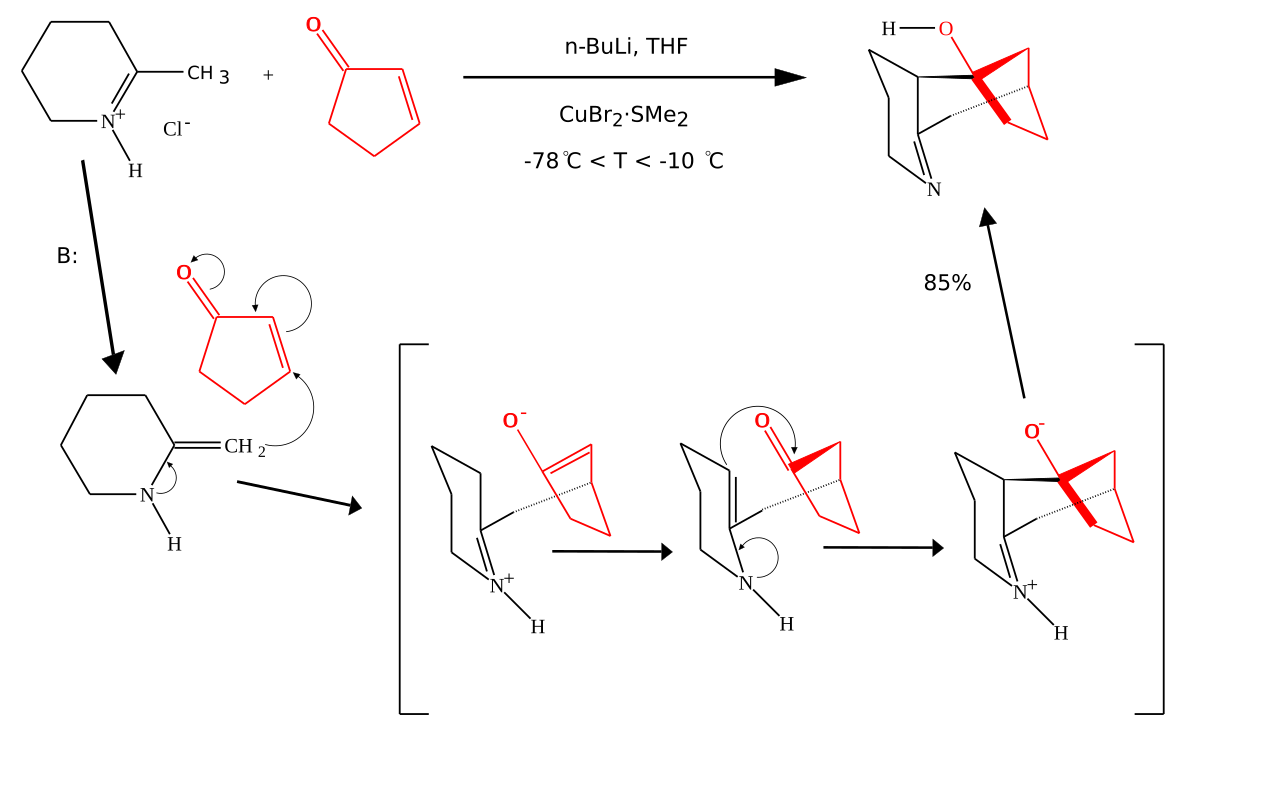
Cycloadditions form cyclic adducts without nucleophiles or electrophiles.

Isilanes · Public domain
A cycloaddition is a chemical reaction in which two or more unsaturated molecules combine to form a cyclic adduct with a net reduction of bond multiplicity. These reactions are a class of addition reactions that permit carbon–carbon bond formation without the use of a nucleophile or electrophile, and many are concerted and pericyclic.
- field
- Organic chemistry
- known_for
- Formation of cyclic adducts via unsaturated molecules; key reactions include Diels-Alder and Huisgen cycloadditions
Lore & Background
Cycloadditions can be described using two systems of notation. An older notation uses parentheses and is based on the size of linear arrangements of atoms in the reactants, e.g., the Diels-Alder reaction is a [4+2]-cycloaddition. A more recent, IUPAC-preferred notation uses square brackets to indicate the number of electrons involved; in this system, both the Diels-Alder and 1,3-dipolar cycloadditions are [4+2]-cycloadditions. Thermal cycloadditions usually have (4n + 2) π electrons and proceed suprafacial-suprafacial. Some thermal cycloadditions with 4n π electrons, such as [2+2]-cycloadditions of ketene and allene derivatives, proceed suprafacial-antarafacial and are classified as pseudopericyclic. Photochemical cycloadditions with 4n π electrons can occur via suprafacial-suprafacial pathways, as in the DeMayo reaction and the dimerization of cinnamic acid. Formal cycloadditions involve charged or radical intermediates or occur in multiple steps, distinguishing them from true pericyclic cycloadditions. Examples include iron-catalyzed [2+2] olefin cycloadditions and formal [3+3]cycloadditions.
Reader's Guide
Cycloadditions are fundamental in organic synthesis, enabling the construction of cyclic compounds without relying on nucleophilic or electrophilic reagents. The Diels-Alder reaction, a [4+2]-cycloaddition, is a cornerstone of synthetic chemistry, with variants such as the inverse electron-demand Diels-Alder and hexadehydro Diels-Alder reactions. Huisgen cycloadditions (1,3-dipolar) and nitrone-olefin cycloadditions are also widely used. The notation systems—one based on atom count and the IUPAC-preferred electron count—allow precise description of these reactions. Thermal and photochemical cycloadditions follow stereochemical rules governed by orbital symmetry, though exceptions exist, such as pseudopericyclic reactions. Formal cycloadditions expand the scope to metal-catalyzed and stepwise processes. The field continues to evolve with developments in supramolecular control and catalyst design, as seen in iron-catalyzed [2+2] cycloadditions.
Did You Know?
- The Diels-Alder reaction is a [4+2]-cycloaddition in both the atom-based and electron-based notation systems.
- Thermal cycloadditions with 4n π electrons, such as [2+2]-cycloadditions of ketene derivatives, are classified as pseudopericyclic reactions.
- The photochemical dimerization of cinnamic acid yields truxillic acids via a suprafacial-suprafacial [2+2] cycloaddition.
- Formal cycloadditions involve charged or radical intermediates, distinguishing them from true pericyclic cycloadditions.
The Thermal Huisgen Cycloaddition
The azide-alkyne Huisgen cycloaddition stands as one of the most recognizable transformations in organic synthesis, uniting an organic azide with a terminal or internal alkyne to produce a 1,2,3-triazole ring. Rolf Huisgen was the chemist who first grasped the full scope of this 1,3-dipolar cycloaddition, laying the groundwork that would later fuel an entire field. In its classic thermal form, the reaction demands elevated conditions—typically around 98 °C sustained for roughly eighteen hours—and delivers the triazole as a mixture of both the 1,4- and 1,5-regioisomeric adducts rather than a single clean product. Interestingly, azides are not the most reactive 1,3-dipoles available, yet they are the go-to choice in the laboratory because they exhibit a relative freedom from competing side reactions and remain stable under ordinary synthetic conditions. The analogous cycloaddition between an azide and a simple alkene has been largely overlooked, as electron-poor olefins show poor reactivity and elimination side reactions complicate the outcome. Only with more electron-deficient dipolarophiles, such as activated olefins or alkynes, has non-metal-catalyzed success been reported.
The Copper-Catalyzed Revolution
In 2002, two independent groups—Morten Meldal at the Carlsberg Laboratory in Denmark, and Valery Fokin together with K. Barry Sharpless at the Scripps Research Institute—published the copper(I)-catalyzed variant of the azide-alkyne coupling, a development that would redefine the reaction's profile. Where the thermal Huisgen process, popularized by Huisgen himself in the 1970s, required high temperatures and delivered a statistical blend of regioisomers, the copper-catalyzed version operates under far milder conditions and furnishes the 1,4-regioisomer of the 1,2,3-triazole as the exclusive product. Sharpless went so far as to dub this transformation "the cream of the crop" of what he called click chemistry and "the premier example of a click reaction." Mechanistically, the process departs from a true concerted 1,3-dipolar cycloaddition: density functional theory calculations indicate that the Cu(I) species first forms a π-complex with the triple bond of the terminal alkyne, after which deprotonation of the acidic terminal hydrogen yields a copper acetylide intermediate. Because of this stepwise pathway, the community now prefers the designation CuAAC—Copper(I)-catalyzed Azide-Alkyne Cycloaddition—over the older Huisgen label.
Practical Execution in the Laboratory
Running the CuAAC reaction in practice is remarkably straightforward, which is a major reason for its popularity. Rather than sourcing a preformed Cu(I) salt, most chemists add a copper(II) compound such as copper(II) sulfate to the reaction flask along with a reducing agent like sodium ascorbate, which generates the active Cu(I) species in situ. This approach has a dual benefit: it removes the need for a separate base and the reducing agent scavenges any stray oxygen that would otherwise oxidize Cu(I) back to Cu(II) and suppress the yield. Because Cu(I) is inherently unstable in aqueous media, a coordinating ligand—most notably tris(benzyltriazolylmethyl)amine, or TBTA—is added to stabilize the metal and boost the reaction outcome. The reaction tolerates a wide range of solvents, from water and alcohols to DMSO, DMF, tBuOH, and acetone, though acetonitrile should be avoided because nitriles coordinate too strongly to Cu(I). Perhaps most appealingly, the starting materials do not need to be fully dissolved, and in many cases the triazole product can simply be filtered off as the sole purification step. Bases such as DIPEA or triethylamine are commonly employed, and the Banert cascade offers an alternative route to NH-1,2,3-triazoles from alkynes.
From Polymers to Biohybrids
Beyond small-molecule synthesis, the CuAAC click reaction has become a workhorse in materials science and bioconjugation. One striking example is the copper(I)-catalyzed polymerization of a bis-azide monomer with a bis-alkyne monomer in the presence of TBTA, which builds a conjugated fluorene-based polymer with a degree of polymerization comfortably exceeding fifty; adding a stopper molecule such as phenyl azide yields well-defined phenyl end-groups. In the biological arena, the reaction has been used to couple polystyrene with bovine serum albumin, where the thiol at Cys-34 of BSA is first functionalized with an alkyne handle. The resulting amphiphilic biohybrid self-assembles in water into micelles thirty to seventy nanometers in diameter that further form aggregates. The method is not without limitations, however. The terminal alkyne can inadvertently participate in free-radical polymerizations, forcing chemists to install a trimethylsilyl protecting group and deprotect only after the radical step is complete. Moreover, the reliance on organic solvents, Cu(I), and inert atmospheres for many polymer couplings has led some to question whether the "click" label is truly appropriate, making a fully aqueous protocol a highly desirable goal.
Gallery



Frequently Asked Questions
Who is Cycloaddition?
Cycloaddition is a class of organic reactions in which two or more molecules bearing double or triple bonds merge to produce a ring-shaped product. It sits within the broader family of addition reactions and is a staple topic in pericyclic-chemistry courses.
What are Cycloaddition's powers or role?
Its signature ability is forging new carbon–carbon bonds in a single step without requiring a nucleophile or an electrophile to drive the process. The reaction typically proceeds in a concerted, pericyclic fashion, meaning all bonds are made and broken in one synchronized electron-flow event.
How does Cycloaddition's story end?
The reaction concludes with the formation of a cyclic adduct, and the overall bond multiplicity of the system drops as π bonds are converted into σ bonds. In plain terms, the unsaturated starting materials are consumed to build the new ring.
Why is Cycloaddition important?
It underpins some of the most widely used transformations in synthetic organic chemistry, most notably the Diels-Alder reaction and the Huisgen azide-alkyne click reaction. Because it assembles rings and C–C bonds so cleanly, it is a cornerstone of pharmaceutical and materials synthesis.
What makes Cycloaddition different from other addition reactions?
Unlike typical polar additions, a cycloaddition does not rely on charge-separated intermediates; instead, it channels electron flow through a cyclic transition state. This pericyclic pathway makes the process highly stereospecific and often gives excellent regioselectivity.
More in Organic Chemistry And Reaction Mechanisms 1-22
Spotted an error? Know more?
This is a living reference — every entry is fact-audited, and reader corrections feed straight into our audit queue. Suggest an edit · See this site's audit record