
Diastereomer
Non-mirror image stereoisomers with distinct physical and chemical properties.

Dapperti · Public domain
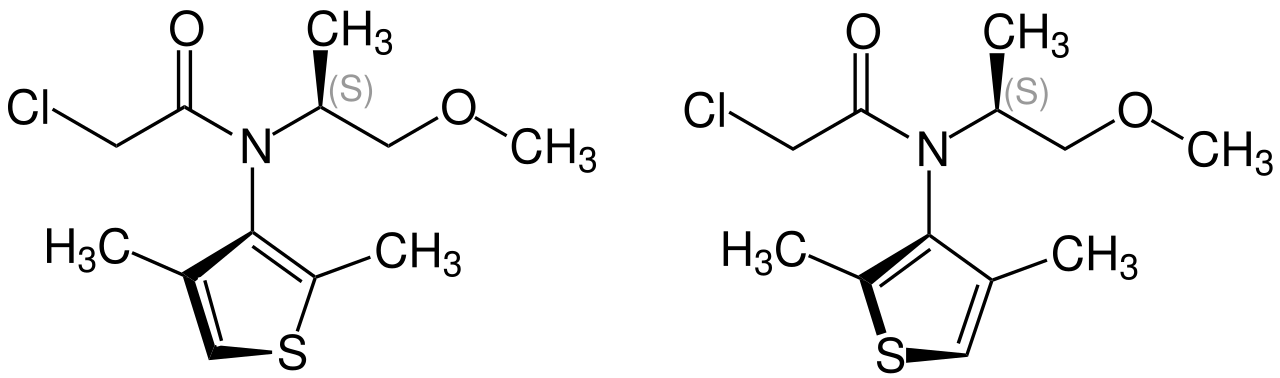
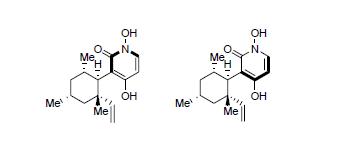
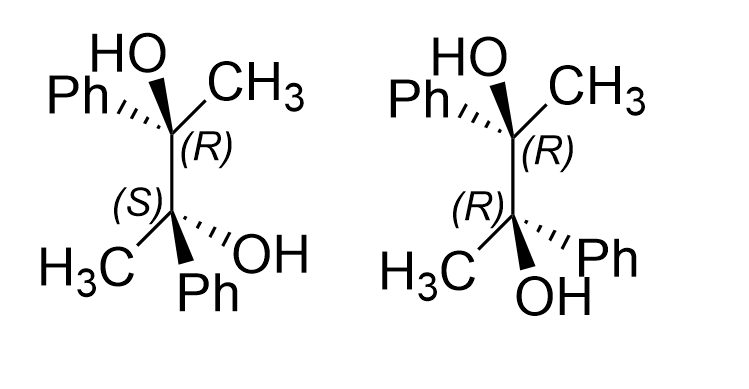
Diastereomers, also called diastereoisomers, are a type of stereoisomer defined as non-mirror image, non-identical stereoisomers. They occur when two or more stereoisomers of a compound have different configurations at one or more (but not all) of the equivalent stereocenters and are not mirror images of each other. Diastereomers differ from enantiomers in that the latter are pairs of stereoisomers that differ in all stereocenters and are mirror images of one another.
- field
- Stereochemistry
- known_for
- Non-mirror image stereoisomers with distinct physical and chemical properties
- related_concepts
- Epimers, enantiomers, syn/anti, erythro/threo, E-Z notation
Lore & Background
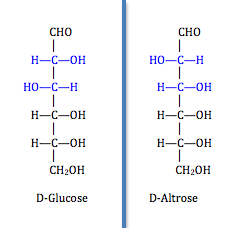
Diastereomers have different physical properties and often different chemical reactivity, unlike most aspects of enantiomers. For example, glucose and galactose are diastereomers; though they share the same molar weight, glucose is more stable than galactose, causing galactose to be absorbed slightly faster in the human body. When two diastereoisomers differ at only one stereocenter, they are called epimers. Each stereocenter typically increases the number of stereoisomers by a factor of two.
Reader's Guide
Diastereomers are fundamental in stereochemistry because their distinct physical and chemical properties enable practical applications such as chiral resolution, where a mixture of enantiomers is separated by converting them into diastereomers and then using chromatography or recrystallization. The prefixes syn and anti describe relative stereochemistry on sp³-hybridised bonds in open-chain molecules, while erythro and threo are older prefixes used for compounds with two adjacent stereocenters, though they are not recommended for general use due to difficulty in application. Diastereomerism also occurs at double bonds, where cis/trans or E-Z notation applies. The number of stereoisomers for a molecule with n chiral centers is generally 2^n, except when meso forms exist due to an internal plane of symmetry. Understanding diastereomers is crucial for predicting reactivity and selectivity in organic reactions, as diastereoselectivity is attributed to torsional and steric interactions.
Did You Know?
- Diastereomers have different physical properties and often different chemical reactivity, unlike most aspects of enantiomers.
- When two diastereoisomers differ at only one stereocenter, they are called epimers.
- Glucose and galactose are diastereomers; galactose is absorbed slightly faster than glucose in the human body.
- The prefixes syn and anti describe relative stereochemistry on sp³-hybridised bonds in open-chain molecules.
The Birth of Diastereomeric Intermediates
In the Darzens condensation, the moment that gives rise to diastereomeric diversity occurs when the resonance-stabilized enolate—generated by deprotonation at the halogenated position of an α-haloester—launches its nucleophilic attack on the carbonyl carbon of a ketone or aldehyde. This carbon–carbon bond-forming step, which mirrors the logic of a base-catalyzed aldol reaction, simultaneously creates two new sp3 tetrahedral centers in the halohydrin intermediate. Because two stereocenters now exist in a single molecule, the intermediate can adopt two distinct diastereomeric configurations. This single step effectively sets the stereochemical trajectory for the entire sequence: whichever diastereomer is assembled here will dictate the geometry of the epoxide that ultimately forms. The choice between the two diastereomeric pathways is not arbitrary; it is shaped by the specific structures of the reactants and by the interplay of kinetic and thermodynamic forces that govern the subsequent steps.
Kinetic Control and the Faster-Forming Diastereomer
When the enolate attacks the carbonyl and two tetrahedral centers appear, the reaction does not treat both diastereomeric outcomes equally. Under kinetic control, the diastereomer that forms most readily and most quickly becomes the predominant species in the reaction mixture. This preference arises because the transition state leading to one diastereomer is lower in energy than the one leading to its counterpart, so the activation barrier is smaller and the rate of formation is greater. The result is that the major diastereomeric halohydrin is simply the one whose assembly pathway is the least demanding in terms of steric or electronic constraints. Once this kinetically favored intermediate accumulates, it proceeds to the SN2 ring-closure step, where the oxygen anion displaces the halide with stereochemical inversion. In this scenario, the final cis or trans epoxide geometry is a direct readout of which diastereomer won the kinetic race at the bond-forming stage.
Thermodynamic Epimerization and the More Stable Diastereomer
The basic conditions inherent to the Darzens condensation introduce a second, competing influence on diastereomeric composition. Before the halohydrin intermediate undergoes its SN2 ring-closure, it can undergo epimerization—a reversible interconversion between the two diastereomeric forms. Because the medium is basic, the equilibrium between these diastereomers is accessible, and the initially formed kinetically favored diastereomer can gradually convert into its counterpart. When this equilibration is complete, the distribution of diastereomers no longer reflects the speed of formation but rather the relative thermodynamic stability of each form. The more stable diastereomer accumulates as the major species, regardless of which one was produced first. Consequently, the cis or trans geometry of the resulting epoxide is governed by chemical thermodynamics rather than kinetics, and the final product mirrors the lower-energy diastereomeric intermediate that survived the equilibration.
Translating Diastereomeric Intermediates into Epoxide Geometry
The diastereomeric identity of the halohydrin intermediate is not merely an abstract mechanistic detail; it directly encodes the stereochemistry of the final glycidic ester. The SN2 ring-closure step, in which the oxygen anion attacks the halide-bearing carbon, proceeds with inversion of configuration at that center. This inversion means that the spatial arrangement of substituents in the diastereomeric intermediate is mapped, with a flip, onto the cis or trans relationship of the epoxide ring. Depending on the particular structures involved, a given Darzens reaction may yield exclusively the cis epoxide, exclusively the trans epoxide, or a mixture of both. The specific outcome is a composite result of how the diastereomer was initially formed or equilibrated and how the inversion step translates that arrangement into the three-dimensional geometry of the epoxide. Thus, diastereomeric control at the intermediate stage is the decisive factor in predicting the stereochemical identity of the product.
Gallery


Frequently Asked Questions
What is a Diastereomer?
A diastereomer (or diastereoisomer) is a stereoisomer that is neither a mirror image nor an identical copy of another stereoisomer of the same molecule. It arises when two or more stereocenters exist and the configurations differ at one or more—but not all—of those centers.
How does Diastereomer differ from Enantiomer?
Enantiomers are mirror-image pairs that differ at every stereocenter, whereas diastereomers are non-mirror-image stereoisomers that differ at only some stereocenters. This partial difference is what gives diastereomers their own distinct physical and chemical behavior.
What makes Diastereomer's properties unique?
Because diastereomers are not mirror images, they possess measurably different melting points, boiling points, solubilities, and reactivities toward other reagents. This contrast sets them apart from enantiomers, which share nearly identical physical properties in achiral environments.
Which related concepts link to Diastereomer?
Diastereomers sit alongside epimers (differing at exactly one center), syn/anti and erythro/threo descriptors, and E-Z double-bond notation. All of these are shorthand ways chemists use to specify which non-mirror-image arrangement a given stereoisomer occupies.
Why is Diastereomer important in stereochemistry?
Diastereomers matter because their distinct physical and chemical properties let chemists separate and identify them without chiral reagents, making them central to mechanism analysis and synthesis planning. Understanding diastereomer relationships is a foundational step in any reaction-mechanism course.
More in Organic Chemistry And Reaction Mechanisms 1-22
Spotted an error? Know more?
This is a living reference — every entry is fact-audited, and reader corrections feed straight into our audit queue. Suggest an edit · See this site's audit record