
E1cB-elimination reaction
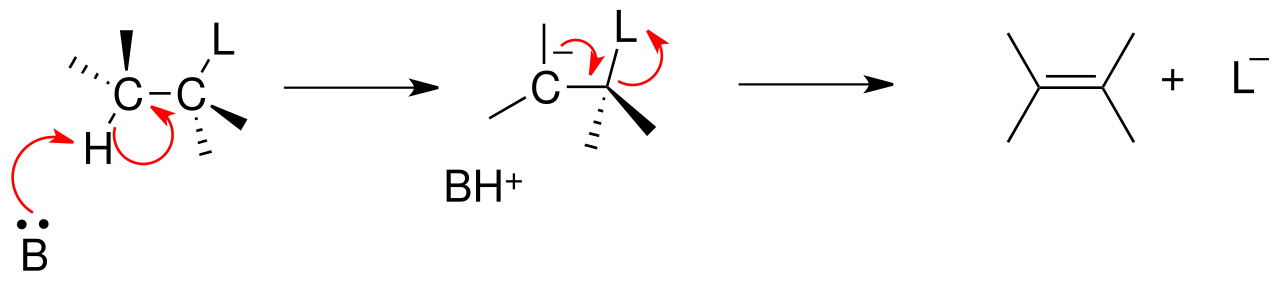
Elimination via a stabilized carbanion intermediate under basic conditions.

Choij · Public domain
The E1cB elimination reaction is a type of elimination reaction that occurs under basic conditions, characterized by the removal of a relatively acidic hydrogen and a poor leaving group. It is one of three major elimination mechanisms, positioned on a spectrum with E1 and E2 reactions, and is distinguished by the formation of a stabilized carbanion intermediate.
- type
- Elimination reaction mechanism
- key_conditions
- Basic conditions, acidic β-hydrogen, poor leaving group
- steps
- Two-step process (deprotonation then elimination)
- rate_determining_step
- Unimolecular (involves one molecular entity)
- intermediate
- Stabilized carbanion (conjugate base of starting material)
- spectrum_position
- One end of a continuous spectrum, opposite E1, with E2 in the middle
Lore & Background
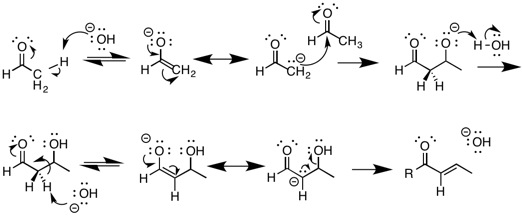
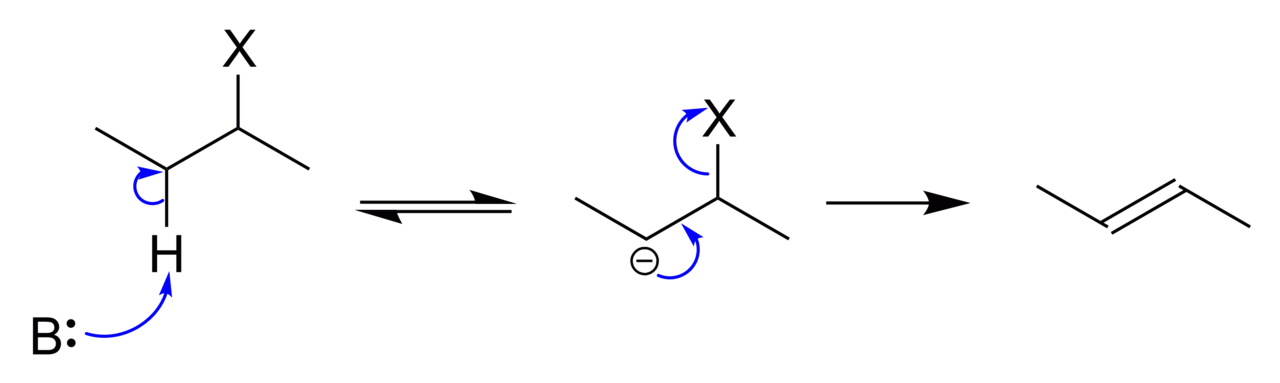
The E1cB mechanism proceeds in two steps. First, a base abstracts a relatively acidic proton from the β-carbon, generating a stabilized anion (the conjugate base). Second, the lone pair on the anion moves to the neighboring α-carbon, expelling the poor leaving group and forming a double or triple bond. The first step may or may not be reversible. The name E1cB stands for Elimination Unimolecular conjugate Base, reflecting the unimolecular rate-determining step and the carbanion intermediate.
Reader's Guide
The E1cB mechanism is significant as one of three fundamental elimination pathways, helping chemists predict reaction outcomes based on substrate structure and conditions. It is favored when the β-hydrogen is acidic, the leaving group is poor (e.g., -OH, -OR, fluorine), and a moderate to strong base is present. The intermediate carbanion is stabilized by resonance or induction, and electron-withdrawing groups, strong bases, poor leaving groups, and polar solvents trigger the mechanism. Distinguishing E1cB from E2 and E1 relies on kinetics: the rate law and kinetic isotope effects are essential. The mechanism is more common in eliminations from alkenes to alkynes and can involve heteroatoms such as nitrogen. Understanding E1cB allows chemists to design reactions and interpret experimental data, particularly when a distinct carbanion intermediate is present rather than a concerted process.
Did You Know?
- The E1cB mechanism is one end of a continuous spectrum, with E1 at the opposite end and E2 in the middle.
- A poor leaving group is necessary for E1cB because a good leaving group would cause the reaction to proceed via E2.
- The mechanism is more common among alkenes eliminating to alkynes than from an alkane to alkene.
- The E1cB mechanism has been observed with heteroatoms such as nitrogen, as in the degradation of ethiofencarb.
The Two-Step Pathway and Its Structural Prerequisites
The E1cB mechanism unfolds in two distinct stages, each governed by specific structural demands. A substrate must carry a sufficiently acidic hydrogen on its β-carbon alongside a notably poor leaving group on the α-carbon—groups such as hydroxyl or alkoxy rather than halides. In the first stage, a moderate-to-strong base abstracts that acidic proton, generating a carbanion intermediate. The stability of this anion is decisive: the more effectively it is stabilized through inductive effects or resonance delocalization of the lone pair, the more the pathway is favored. Electron-withdrawing groups on the substrate, a polar solvent, and a strong base all push the reaction toward this route. In the second stage, the lone pair on the anion migrates to the adjacent atom, expelling the poor leaving group and forging a new double or triple bond. The mechanism's name—Elimination Unimolecular conjugate Base—encapsulates the essence: two substituents are lost, the rate-determining step involves only one molecular entity, and the intermediate is the conjugate base of the starting material.
A Position on the Elimination Spectrum
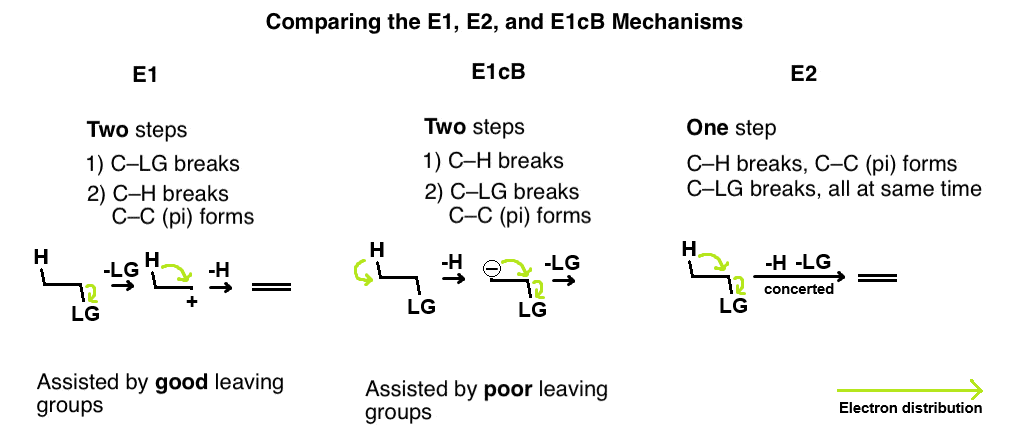
Rather than treating E1, E2, and E1cB as rigidly separate categories, chemists increasingly regard them as points along a continuous spectrum of elimination behavior. At one extreme sits the E1 mechanism, where a good leaving group such as bromine or tosylate departs first to create a carbocation, and only afterward does a weak base remove the now-acidified neighboring hydrogen. At the opposite extreme lies E1cB, in which the acidic proton is abstracted first and the poor leaving group is expelled second. The E2 mechanism occupies the middle ground: a strong base and a good leaving group cooperate in a single concerted step, with proton removal and leaving-group departure occurring simultaneously through one transition state. The key structural differentiator is the acidity of the β-hydrogen paired with the quality of the leaving group. E1cB substrates demand the most acidic β-protons and the poorest leaving groups, while E1 substrates feature the least acidic protons and the best leaving groups. This continuum framework helps explain why borderline cases can shift mechanism depending on subtle changes in substrate structure or reaction conditions.
Experimental Discrimination and Kinetic Evidence
Because the three elimination pathways can yield identical products, distinguishing them in practice demands careful kinetic analysis. Rate laws and the kinetic isotope effect serve as the primary diagnostic tools for assigning a mechanism. A particularly elegant line of evidence comes from comparing different halogen leaving groups on the same substrate. In one well-known case, a molecule bearing both chlorine and fluorine was subjected to elimination conditions. Chlorine is the superior leaving group by conventional measures, yet fluorine was the atom actually expelled. This outcome is only explainable if a discrete carbanion intermediate forms first—the anion is better stabilized by the remaining chlorine than by fluorine—ruling out a concerted E2 pathway that would have favored chlorine departure. The observation that the products could not arise from the most stable concerted mechanism provides direct evidence for the stepwise E1cB route. Ultimately, definitive mechanism assignment rests on applying chemical kinetics: measuring how reaction rate depends on substrate concentration, base concentration, and isotopic substitution at the β-hydrogen position.
Broader Scope and Real-World Relevance
Although the E1cB mechanism is most often discussed in the context of carbon-based eliminations, its scope extends well beyond. The pathway has been documented with heteroatoms such as nitrogen, as illustrated by the atmospheric degradation of ethiofencarb, a carbamate insecticide. In that case, deprotonation of the amine nitrogen yields an amide anion stabilized by conjugation with a neighboring carbonyl group, and the subsequent elimination releases a phenol derivative. The compound's relatively short atmospheric half-life is a direct consequence of this facile E1cB pathway. Substrate classes that readily undergo E1cB elimination include alcohols and fluoroalkanes, both of which feature poor leaving groups. There is also a noted tendency for this mechanism to appear more frequently in alkene-to-alkyne eliminations than in alkane-to-alkene cases, possibly because sp² hybridization renders the relevant protons slightly more acidic. The mechanism is not confined to any single element or bond type, making it a broadly applicable concept across organic and environmental chemistry.
Gallery


Frequently Asked Questions
Who is the E1cB-elimination reaction?
The E1cB is a two-step elimination mechanism that operates under basic conditions: a base first strips away an acidic β-hydrogen to generate a stabilized carbanion, and that intermediate then expels a poor leaving group to give an alkene. It occupies one extreme of the elimination spectrum, sitting opposite the E1 pathway with the E2 mechanism in the middle.
What are the E1cB-elimination reaction's powers and role?
Its signature ability is producing a resonance-stabilized carbanion after the rate-determining deprotonation step, which lets it eject leaving groups far too stubborn for either E1 or E2 pathways. It thrives specifically in basic environments where the β-hydrogen is acidic enough to be abstracted and the leaving group is notably poor.
How does the E1cB-elimination reaction's story end?
The narrative resolves when the carbanion intermediate undergoes a unimolecular collapse: the negatively charged carbon pushes electron density to eject the leaving group and forge a new π-bond, delivering the final alkene product. Because this breakdown involves only one molecular entity, the overall kinetics are first-order in substrate.
Why is the E1cB-elimination reaction important to the canon?
It completes the trio of major elimination mechanisms alongside E1 and E2, providing a viable route for substrates that pair an acidic β-hydrogen with a poor leaving group—conditions under which neither E1 nor E2 would work. Its existence also demonstrates that elimination mechanisms form a continuous spectrum rather than three rigid, isolated categories.
What sets the E1cB-elimination reaction apart from its E1 and E2 siblings?
Unlike E1, which routes through a carbocation, or E2, which proceeds in a single concerted step, the E1cB travels through a carbanion intermediate in a clearly defined two-step sequence. Its rate-determining step is the unimolecular breakdown of that intermediate, and it specifically demands a poor leaving group plus an acidic β-hydrogen—conditions that would actually disfavor the other two mechanisms.
More in Organic Chemistry And Reaction Mechanisms 1-22
Spotted an error? Know more?
This is a living reference — every entry is fact-audited, and reader corrections feed straight into our audit queue. Suggest an edit · See this site's audit record