
Atropisomer
Stereoisomers arising from hindered rotation about a single bond.

User:Calmkelp · Public domain
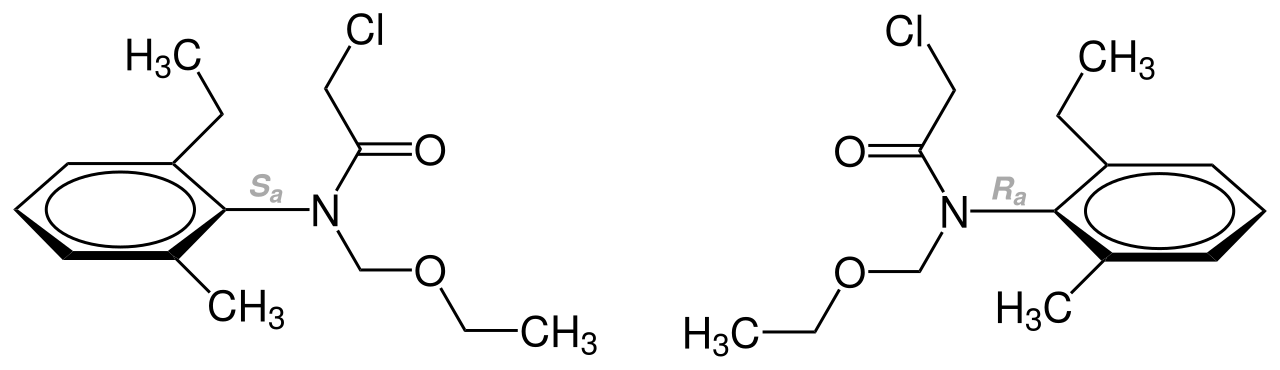
Atropisomers are a kind of stereoisomer arising because of hindered rotation about a single bond, where energy differences due to steric strain or other contributors create a barrier to rotation that is high enough to allow for isolation of individual rotamers. They occur naturally and are of occasional importance in pharmaceutical design. When the substituents are achiral, these conformers are enantiomers (atropoenantiomers), showing axial chirality; otherwise they are diastereomers (atropodiastereomers).
- field
- Stereochemistry
- known_for
- Axial chirality due to hindered rotation about a single bond
- refined_definition_by
- Michinori Ōki
Reader's Guide
Atropisomers represent a significant class of stereoisomers in chemistry, defined by hindered rotation about a single bond that allows isolation of individual rotamers. Their importance spans natural products, pharmaceutical design, and asymmetric synthesis. The stability of individual atropisomers is conferred by repulsive interactions that inhibit rotation, influenced by steric bulk and bond length and rigidity. Commonly studied by dynamic nuclear magnetic resonance spectroscopy, atropisomerism is a form of fluxionality. When the barrier to racemization is high, as illustrated by BINAP ligands, the phenomenon becomes of practical value in asymmetric synthesis. Methaqualone is a classical example of a drug molecule exhibiting atropisomerism. Most examples focus on biphenyl derivatives, though some acyclic systems like amides and thioamides also exhibit the phenomenon due to partial double bond character. The ability to assign axial stereochemistry using Newman projections and Cahn–Ingold–Prelog priority rules, along with synthetic methods such as coupling reactions and resolution techniques, has enabled broad applications in catalysis and drug design. Natural products like vancomycin and knipholone demonstrate the biological relevance of atropisomerism, while drugs such as telenzepine show that enantiomers can have vastly different activities.
Did You Know?
- Michinori Ōki defined atropisomers as interconverting with a half-life of at least 1000 seconds at a given temperature.
- Methaqualone is not a classical example of a drug molecule that exhibits atropisomerism; it does not have a chiral axis due to hindered rotation about a single bond.
Origins and Defining the Phenomenon
The concept of atropisomerism traces back to 1922, when George Christie and James Kenner first experimentally observed the phenomenon in a tetra-substituted biphenyl diacid. The term itself arrived a decade later in 1933, when German biochemist Richard Kuhn coined "atropisomer" from the Greek word atropos, meaning "not to be turned," for Karl Freudenberg's landmark volume on stereochemistry. The definition was later sharpened by Michinori Ōki, who recognized that the interconversion of conformers is temperature-dependent. He established a practical criterion: for a pair of rotamers to qualify as true atropisomers, their interconversion half-life must exceed 1000 seconds at a specified temperature. At 300 K, this corresponds to an energy barrier of roughly 93 kJ per mole, or about 22 kcal per mole. This quantitative threshold transformed atropisomerism from a vague notion of restricted rotation into a rigorously defined stereochemical category with measurable boundaries.
Structural Diversity and Energetic Foundations
Atropisomerism is not confined to a single structural motif. While the most extensively studied examples involve biphenyl derivatives—where a full complement of ortho substituents blocks free rotation—heteroaromatic systems with hindered carbon-nitrogen or nitrogen-nitrogen bonds also display the phenomenon. Even aliphatic frameworks, such as cyclohexane rings joined by a single bond, can exhibit atropisomerism when sufficiently bulky groups are present. Acyclic systems like amides and thioamides participate as well, owing to the partial double-bond character of their C–N linkages. The energetic origin of the rotational barrier lies in repulsive steric interactions between the substituents flanking the bond. In principle, both the bulk of those groups and the length and rigidity of the connecting bond influence the height of the barrier. Because atropisomerism is a form of fluxionality, dynamic nuclear magnetic resonance spectroscopy is the primary analytical tool for studying it, supplemented by theoretical calculations and observations of reaction outcomes and product distributions.
Building Axially Chiral Molecules
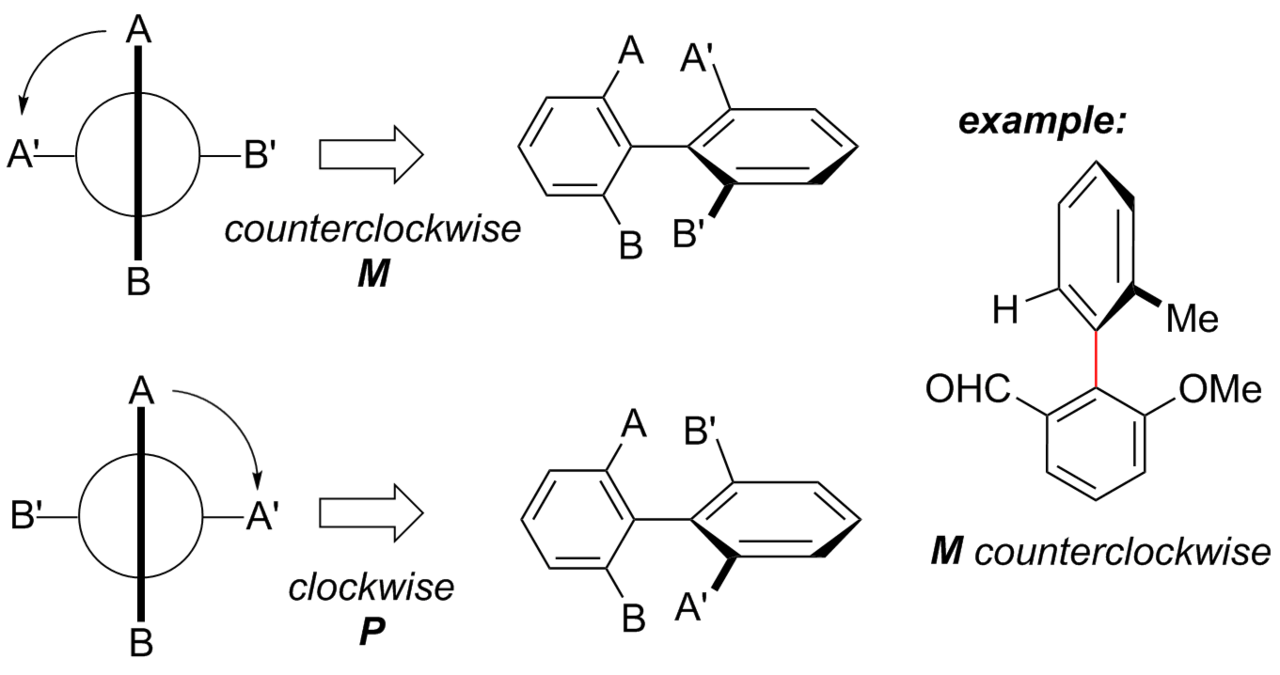
The laboratory preparation of axially chiral biaryls relies on a suite of coupling strategies. Ullmann coupling, the Suzuki–Miyaura reaction, and palladium-catalyzed arylation of arenes are the principal methods for forging the central C–C bond. Once a racemic biaryl is obtained, classical resolution techniques separate the enantiomers. Alternatively, diastereoselective coupling can be achieved by installing a chiral bridge between the two aryl rings or by attaching a chiral auxiliary near the axial axis. Enantioselective approaches include employing a chiral leaving group on one of the biaryl partners or running the reaction under oxidative conditions with chiral amines that set the axial configuration in a single step. A particularly elegant isolation strategy is seed-directed crystallization: 1,1′-binaphthyl, for instance, crystallizes directly from its melt as individual enantiomers rather than as a racemic solid. Assigning the absolute configuration requires a Newman projection along the hindered axis, applying Cahn–Ingold–Prelog priorities to the ortho and sometimes meta substituents, and then reading the helicity as P or Δ for clockwise, M or Λ for counterclockwise, or alternatively as Ra and Sa by ranking all four groups.
From Catalysis to the Clinic
The practical value of atropisomerism shines brightest in asymmetric catalysis and medicinal chemistry. Axially chiral biaryls such as BINAP, QUINAP, and BINOL serve as chiral ligands in metal-catalyzed hydrogenation, epoxidation, allylic alkylation, Grignard additions, Ullmann couplings, and Suzuki reactions. A more recent advance incorporates a five-membered imidazole into the atropisomer scaffold, yielding a phosphorus-nitrogen ligand capable of enantioselective A3-coupling. In drug design, methaqualone—a well-known anxiolytic and hypnotic-sedative—exemplifies a pharmaceutical molecule whose activity is tied to atropisomerism. Nature, too, exploits this stereochemistry: vancomycin, isolated from an Actinobacterium, and knipholone are naturally occurring atropisomers, while mastigophorene A has been linked to nerve-growth promotion. A striking synthetic application transfers the axial asymmetry of an iodoaryl atropisomer derived from (S)-valine, with a 24.3 kcal/mol interconversion barrier, into a new tetrahedral stereocenter via a Barton–McCombie radical sequence, delivering the (S,S) dihydroindolone with full stereochemical fidelity.
Gallery




Frequently Asked Questions
Who is Atropisomer?
Atropisomer is a stereoisomer that exists because bulky substituents physically block free rotation around a particular single bond, raising the energy barrier high enough that the individual twisted forms can be isolated. Unlike ordinary conformers that interconvert rapidly, an atropisomer stays locked in one rotameric shape under normal conditions.
What are Atropisomer's powers/role?
Its signature ability is axial chirality: the molecule adopts a non-superimposable mirror-image geometry purely from the twist about one bond. If every attached group is achiral, the two forms are enantiomers (atropoenantiomers); if any substituent already carries chirality, the pair becomes diastereomers (atropodiastereomers).
Who refined Atropisomer's definition?
The modern, precise criteria for what qualifies as a true atropisomer versus a rapidly interconverting conformer were sharpened by Michinori Ōki, whose work set the standard the field still uses today.
Why is Atropisomer important in the canon?
It appears in naturally occurring molecules and plays a recurring role in pharmaceutical design, where locking a drug into one specific twisted geometry can dramatically change its binding and activity. In the broader series it belongs to the Stereochemistry field and is best known for proving that a single bond can carry genuine stereochemical information.
How does Atropisomer's story end / what is its fate?
There is no narrative endpoint—atropisomerism is a persistent structural feature rather than a transient intermediate. As long as the steric or electronic barrier to rotation exceeds the thermal energy available, the isolated rotamer remains locked in its twisted configuration indefinitely.
More in Organic Chemistry And Reaction Mechanisms 1-22
Spotted an error? Know more?
This is a living reference — every entry is fact-audited, and reader corrections feed straight into our audit queue. Suggest an edit · See this site's audit record