
Cis–trans isomerism
Geometric isomerism describes cis and trans arrangements of atoms.

Jü · Public domain
Cis–trans isomerism, also known as geometric isomerism, describes certain arrangements of atoms within molecules where functional groups are on the same side (cis) or opposing sides (trans) of a plane. This type of configurational isomerism occurs in both organic molecules and inorganic coordination complexes, and is distinct from conformational isomerism where forms easily interconvert.
- field
- Chemistry
- known_for
- Describing geometric isomerism in molecules with restricted rotation, such as double bonds or ring structures
- type
- Stereoisomerism
- related_notation
- E–Z notation for alkenes with multiple different substituents
Lore & Background
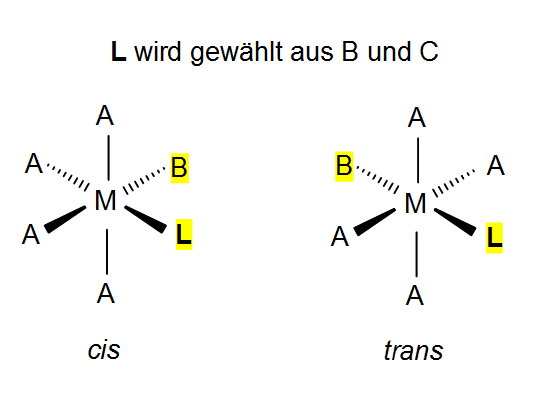
The prefixes 'cis' and 'trans' are from Latin, meaning 'this side of' and 'the other side of', respectively. In chemistry, cis indicates that functional groups are on the same side of some plane, while trans indicates they are on opposing sides. Cis–trans isomers are stereoisomers—pairs of molecules with the same formula but different three-dimensional orientations of functional groups. According to IUPAC, 'geometric isomerism' is an obsolete synonym of 'cis–trans isomerism'. Cis–trans isomerism commonly occurs in organic compounds with double bonds or ring structures, where bond rotation is restricted. For example, but-2-ene and 1,2-dichlorocyclohexane exhibit such isomerism. The physical properties of cis and trans isomers differ: cis isomers tend to have higher boiling points and lower melting points due to polarity and symmetry differences, while trans isomers often have higher melting points and lower boiling points. For instance, cis-pent-2-ene boils at 37 °C and trans-pent-2-ene at 36 °C; cis-1,2-dichloroethene boils at 60.3 °C and trans at 47.5 °C. In inorganic chemistry, cis–trans isomerism occurs in coordination complexes. Square planar Pt(NH3)2Cl2 has cis and trans isomers; the cis isomer (cisplatin) has antitumor activity, while the trans isomer (transplatin) does not. Octahedral complexes of formula MX4Y2 also exhibit cis–trans isomerism, with adjacent or opposite ligand positions. For acyclic systems, trans isomers are generally more stable than cis isomers due to steric interactions, though exceptions exist (e.g., 1,2-difluoroethylene) known as the cis effect.
Reader's Guide
Cis–trans isomerism is a fundamental concept in stereochemistry, describing how the spatial arrangement of substituents affects molecular properties and reactivity. Its significance spans organic and inorganic chemistry, influencing physical properties such as boiling point, melting point, and polarity. For example, the cis isomer of butenedioic acid has very different properties from the trans isomer. In medicine, the cis isomer of Pt(NH3)2Cl2 (cisplatin) is a key chemotherapy drug, while the trans isomer is inactive. The concept also underlies the E–Z notation system, which unambiguously describes alkene stereochemistry using Cahn–Ingold–Prelog priority rules. Understanding cis–trans isomerism is essential for predicting stability, reactivity, and intermolecular forces, as seen in the higher melting points of trans alkenes due to better packing. The legacy of this isomerism includes its role in explaining the behavior of diazenes, where only the cis isomer can reduce alkenes, and in the synthesis of coordination complexes via the trans effect.
Did You Know?
- Cis and trans are from Latin meaning 'this side of' and 'the other side of', respectively.
- Cis–trans isomers are stereoisomers with the same formula but different three-dimensional orientations of functional groups.
- The cis isomer of Pt(NH3)2Cl2 (cisplatin) has antitumor activity, while the trans isomer (transplatin) does not.
- For acyclic systems, trans isomers are generally more stable than cis isomers, except in cases like 1,2-difluoroethylene (the cis effect).
Origins and Place in Stereochemistry
Cis–trans isomerism—sometimes still called geometric isomerism, though IUPAC now regards that label as outdated—describes how molecules with identical atomic formulas can differ in the three-dimensional placement of their functional groups. The terminology draws on Latin: cis means "this side of" and trans means "the other side of," so the prefixes simply tell you whether two substituents sit on the same face of a molecular plane or on opposite faces. These isomers belong to the broader family of stereoisomers and, more specifically, to configurational isomerism, meaning the spatial arrangement cannot be changed without breaking bonds. They are diastereomers of one another. The phenomenon is not limited to organic molecules; inorganic coordination complexes display it as well. Importantly, cis and trans labels are reserved for situations where rotation is genuinely restricted—typically by a double bond or a ring. When two geometric forms can freely interconvert, as in most open-chain single-bonded structures, chemists instead use the terms "syn" and "anti" to describe the relative orientations.
Physical Property Divergence
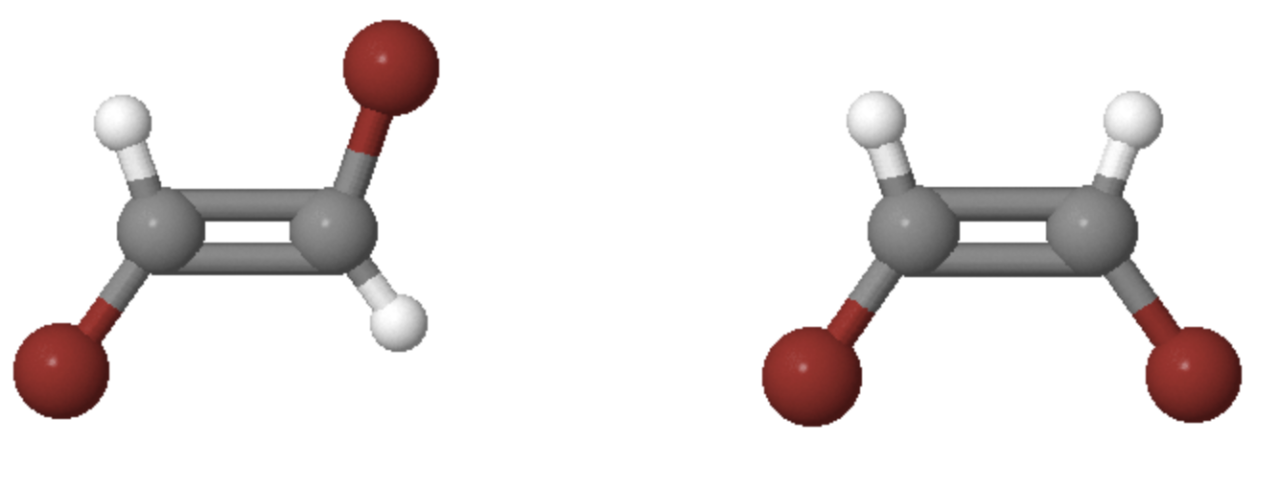
Although cis and trans isomers share the same molecular formula, their distinct shapes produce measurably different physical properties. Polarity governs boiling-point differences: in the cis form, bond dipoles reinforce one another, creating a net molecular dipole that strengthens intermolecular dipole–dipole (Keesom) forces on top of London dispersion forces. The trans form, by contrast, has its dipoles cancel, yielding a net zero dipole moment (though a non-zero quadrupole moment remains). This is vividly illustrated by the two 1,2-dichloroethenes: the cis isomer boils at 60.3 °C while the trans isomer boils at just 47.5 °C. For less polar molecules like pent-2-ene the gap shrinks to a single degree (37 °C versus 36 °C). Melting points follow a different logic—symmetry. A straighter, more symmetrical trans molecule packs more efficiently in a crystal lattice, raising its melting point. Oleic acid (cis) melts at 13.4 °C and is liquid at room temperature, whereas its trans counterpart, elaidic acid, melts at 43 °C and is solid. Trans alkenes also tend to be less dense and less soluble in inert solvents than their cis analogues.
Stability and the Cis Effect
In most acyclic systems the trans isomer is the thermodynamically preferred form. The reason is steric: in the cis arrangement the two substituents crowd each other on the same side of the double bond, creating unfavorable non-bonded interactions. This penalty shows up in thermochemical data—trans isomers release less heat upon combustion, confirming their greater stability. The Benson group-additivity dataset quantifies the effect, assigning cis isomers a stability penalty of roughly 1.10 kcal/mol relative to their trans partners. Yet the rule is not absolute. Several halogen- and oxygen-substituted ethylenes, including 1,2-difluoroethylene and 1,2-difluorodiazene (FN=NF), defy the expectation and place the cis isomer in the lower-energy position. Chemists refer to this counterintuitive preference as the "cis effect." The existence of these exceptions reminds us that electronic factors—lone-pair repulsions, orbital interactions, and the specific nature of the substituents—can override the simple steric argument that governs most hydrocarbon cases.
E–Z Notation and the NMR Fingerprint
The simple cis/trans labels break down the moment an alkene carries two or more different substituents on each carbon of the double bond. For tri- and tetrasubstituted alkenes, IUPAC prescribes the E–Z system, which relies on the Cahn–Ingold–Prelog priority rules. Each carbon of the double bond is examined separately: the substituent with the higher atomic number receives higher priority. If the two higher-priority groups fall on the same side, the configuration is designated Z (from the German zusammen, "together"); if they fall on opposite sides, it is E (from entgegen, "opposed"). Crucially, Z does not always coincide with cis and E does not always coincide with trans, because the two systems compare different pairs of groups. Beyond nomenclature, NMR spectroscopy offers a direct experimental handle on the geometry. Vicinal coupling constants (³J_HH) between the two vinylic hydrogens are characteristically larger for trans isomers—typically around 15 Hz, ranging from 12 to 18 Hz—than for cis isomers, which usually show values near 8 Hz, spanning 0 to 12 Hz. This difference makes NMR a reliable tool for assigning alkene geometry in the laboratory.
Gallery



Frequently Asked Questions
Who is Cis–trans isomerism?
It is a form of stereoisomerism in which substituents are locked on the same side (cis) or opposite sides (trans) of a rigid structural feature such as a double bond or a ring. Also called geometric isomerism, it applies to both organic molecules and inorganic coordination complexes.
What are Cis–trans isomerism's powers/role?
It describes the fixed spatial arrangement of atoms and functional groups when free rotation is prevented, most commonly around a C=C bond or within a cyclic framework. Each geometric arrangement produces a distinct set of physical and chemical properties for that molecule.
How does Cis–trans isomerism's story end?
When each carbon of a double bond bears two different substituents, the simple cis/trans labels become ambiguous, so chemists switch to the E–Z notation system for an unambiguous description. Cis–trans remains the go-to shorthand for simpler alkenes and ring systems where the distinction is clear.
Why is Cis–trans isomerism important?
Because the spatial placement of groups alters a molecule's shape, dipole moment, and reactivity, meaning the cis and trans forms can behave very differently in biological receptors or industrial processes. Recognizing this isomerism is therefore essential for drug design, materials science, and planning synthetic routes.
What's the difference between Cis–trans isomerism and conformational isomerism?
Cis–trans isomers are configurational: they cannot interconvert without breaking a bond, so each form is a stable, isolable species. Conformational isomers, by contrast, rotate freely around single bonds at room temperature and are merely transient arrangements of the same molecule.
More in Organic Chemistry And Reaction Mechanisms 1-22
Spotted an error? Know more?
This is a living reference — every entry is fact-audited, and reader corrections feed straight into our audit queue. Suggest an edit · See this site's audit record